
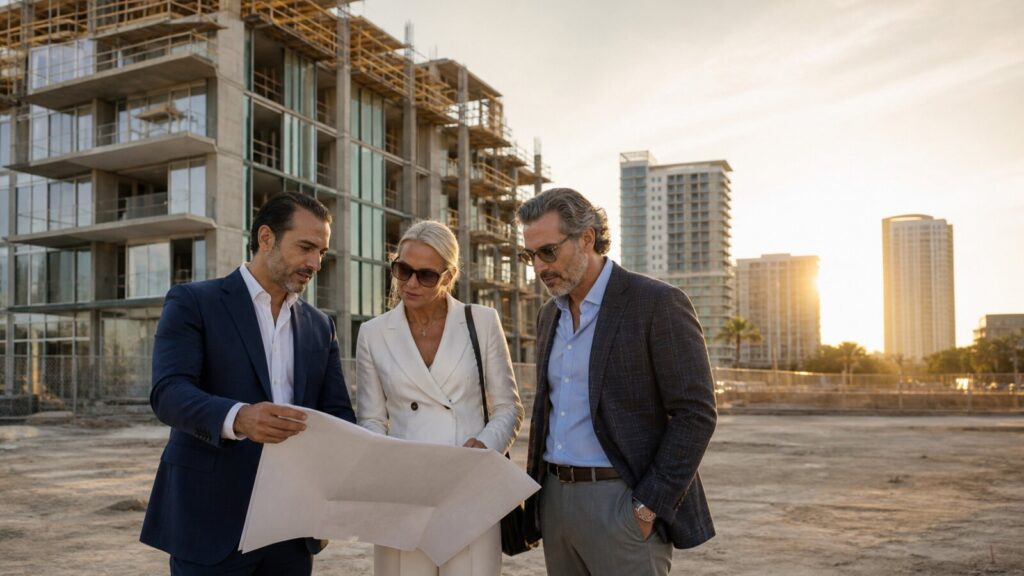
A family office rarely lacks capital or good advisors. What it often lacks is a construction-side voice that sits entirely on the owner’s side of the table. Family office real estate development in Miami usually involves a land acquisition, an entitlement path, a design team, a contractor and a lender, and each of them has its own incentives. This article explains where an owner’s representative fits into that structure, which decisions deserve the most scrutiny before capital is committed, and how principals and their advisors can keep control of a project without managing the daily work themselves. It is written for family offices, private investors and the attorneys, brokers and wealth advisors who guide them in Miami-Dade, Broward and Palm Beach.
Why development differs from buying a stabilized asset
Acquiring an income-producing building is largely a financial exercise. Developing one adds execution risk: the site may carry constraints that are not obvious, approvals may take longer than modeled, and costs can move while the design is still evolving. The exposure is real because most of the capital is committed before anyone can see how the building will actually perform.
That is why our view is that the most expensive mistakes in construction happen before construction begins. A weak site decision, an incomplete budget or a contract that shifts risk to the owner is difficult to correct once the money is moving. A principal who treats the pre-construction phase as seriously as the closing will usually have better options later.
What an owner’s representative does for a family office
Owner’s representation is a role defined by who it works for. The architect is responsible for the design, the contractor for the construction, and the broker for the transaction. An owner’s representative is responsible for the owner’s interests across all of them. For a family office, that typically includes:
- Acquisition and feasibility support that tests what can realistically be built and what it may involve before the purchase is final.
- Budget and schedule review that questions assumptions and identifies what has not yet been priced.
- Team selection that compares architects, engineers and contractors on scope and fit rather than on the lowest headline number.
- Contract and change-order oversight so that terms and cost movements are understood by the owner as they happen.
- Reporting that fits the way a family office makes decisions, with clear summaries for principals and advisors who are not on the site.
Our owner’s representation service describes how we approach that role, and our guide on when to bring in an owner’s representative addresses timing.
“We already have an architect and a general contractor”
This is the most common reaction, and it is reasonable. A good architect and a good contractor are essential, and an owner’s representative does not replace either. The difference is accountability. Your architect answers for the design and your contractor answers for the build; neither is retained to protect the owner’s capital across both. When the design runs ahead of the budget, or a contractor proposes a change that benefits the schedule more than the owner, someone needs to be asking the owner’s question. In a family office structure, where principals are often not in Miami week to week, that is the gap the representative closes.
Family office real estate development in Miami: decisions that deserve early attention
Site and feasibility
Before closing on land, an owner benefits from a clear view of zoning, flood and wind considerations, utilities, access and the approvals the project will need. Our article on how to know if a property is worth developing walks through the questions to ask; our due diligence and feasibility work puts them into a structured review. Approval requirements and timelines depend on the jurisdiction, so treat any assumption about them as something to verify.
Budget structure
A budget is only as reliable as its assumptions. Ask what is included, what is allowance and what is excluded. Confirm that contingency is set for the stage of design rather than a generic percentage, and decide in advance who controls it. Owners who agree on these rules at the start have fewer disagreements when numbers move.
Contract terms
The agreement with the contractor allocates risk. Pricing method, allowances, change-order procedures, delay provisions and payment terms all matter, and they should be reviewed by the owner’s attorney with construction input. Our guide to construction contract review for owners highlights the provisions that most often surprise first-time developers.
Lien protection and payment discipline
Florida’s construction lien law places obligations on owners as well as contractors, including the recording of a notice of commencement before work begins, as outlined in section 713.13 of the Florida Statutes. Payment procedures and documentation should be set up with your attorney before the first draw so that the owner can show what has been paid and to whom.
A checklist for principals and advisors
- Define the investment objective: hold, sell or reposition, and the time horizon.
- Confirm who on the owner’s side has authority to approve changes and spend.
- Complete feasibility before the land purchase is irrevocable, where the contract allows.
- Test the budget against the design stage and list what is not yet priced.
- Compare contractors on scope, team and terms, not only on price.
- Have counsel review the agreements with construction input.
- Set reporting expectations: what the family office sees, how often and in what form.
- Plan how changes will be requested, priced and approved. See our owner’s guide to change order management.
Working with the advisors you already have
Family offices typically work with attorneys, accountants, brokers and wealth advisors who know the principal’s goals better than any contractor will. A good owner’s representative complements that group. The role brings construction experience to conversations that are otherwise about structure, tax and financing, and translates technical issues into decisions that principals can make. We built our practice on construction experience going back to 1998, and the focus is on the owner’s position. If SBC were ever to take a construction role on a project, it would be scoped, priced and approved separately, and the owner remains free to bid it out.
Governance: who decides, and how fast
Family offices often have a decision-making process that is deliberate by design: an investment committee, a principal’s approval, counsel’s review. Construction moves on a different clock. Pricing is held for a limited time, subcontractors need answers, and a delayed decision on a design change can affect the schedule. Agree before the project starts on who may approve what, up to which threshold, and how quickly. A small number of pre-approved decision rights, with clear escalation for larger items, usually keeps the project moving without taking control away from the principal.
Written reporting helps here. A short monthly summary covering budget status, schedule, open decisions and risks gives the family office an accurate picture without requiring anyone to read a stack of contractor documents. It also creates a record that is useful if the project is later sold, refinanced or reviewed by the next generation.
Frequently asked questions
Does a family office need an owner’s representative for every project?
Not necessarily. The value tends to increase with the size and complexity of the project and with the distance between the principal and the day-to-day work.
Is an owner’s representative the same as a construction manager?
No. It depends on who retains the manager and whom they answer to. A construction manager’s duties and loyalties follow whoever hires them, while an owner’s representative is retained solely to protect the owner’s interests across the whole project.
When should we involve an owner’s representative?
Ideally before the land or building is purchased and before design and contractor decisions are locked in, since that is when the most important choices are made.
Can an owner’s representative work alongside our existing team?
Yes. The role is designed to work with your architect, attorney and contractor rather than replace them.
Does this apply outside Miami-Dade?
Yes. We support owners in Miami-Dade, Broward and Palm Beach, and each jurisdiction has its own approval practices that should be confirmed for your site.
Request a project strategy session
If your family office is evaluating a development in South Florida, request a 30-minute project strategy session before committing capital. We will review the site, the budget and the contract approach from the owner’s side of the table. You can reach us through our contact page to get started.