
On many projects, the monthly payment requests that arrive once construction starts add up to the largest outflows an owner will approve. Each one asks the owner to confirm that the work shown has actually been built, that it matches the contract and that the money going out still leaves enough to finish. Construction draw review for owners is the discipline of answering those questions before paying, and it is where an owner’s representative often earns the most visible value. This article explains what a payment application contains, what an owner or lender should test before approving it and how to build a review routine that does not depend on trust alone. If you are building or renovating in Miami-Dade, Broward or Palm Beach, the routine below applies whether you act alone or through advisors.
What is actually in a payment application
Most construction contracts have the contractor submit a periodic application showing the contract sum, the value of work completed to date, any stored materials, retainage held back and the amount now requested. The backbone is usually a schedule of values: the contract broken into line items that the contractor and owner agreed on. If the schedule of values is loose at the start, every later application inherits the looseness. A foundation line that is front-loaded, or a closeout line that is too small, quietly shifts risk onto the owner before any work is done.
That is why the review begins at contract signing, not at the first draw. Our guide to construction contract review for owners covers the payment terms worth settling up front, and the same attention applies to the schedule of values that will govern every request after it.
Construction draw review for owners: the questions that matter
Does the percentage complete match what is built?
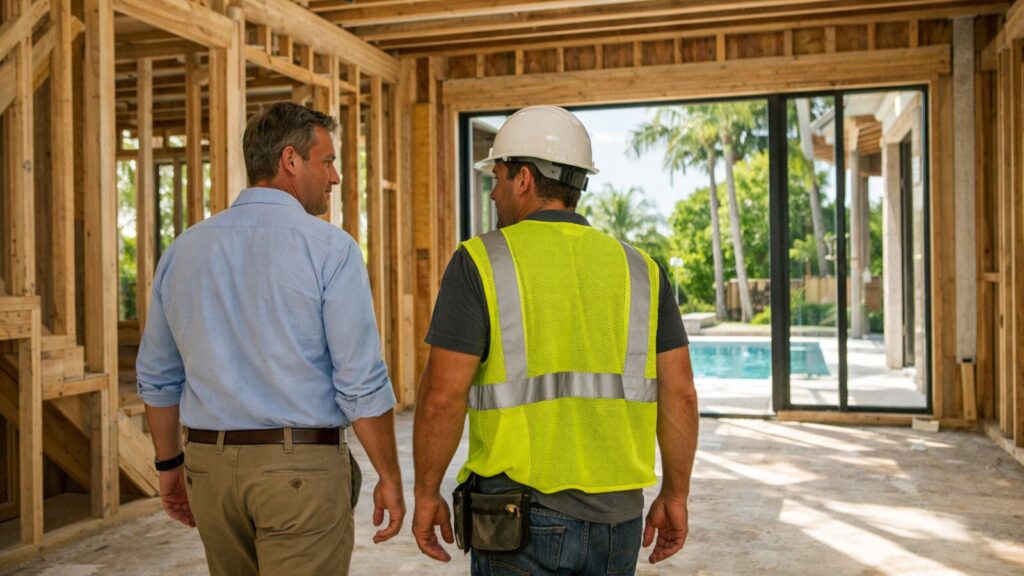
Each line item claims a percentage. Someone who understands the work should walk the site and compare the claim with reality, ideally with dated photographs. Overstated progress in early draws leaves less money behind the last stages, which is when the hardest and least glamorous work remains.
Is the payment tied to the right scope?
Approved changes should appear as their own lines with supporting documents. Unapproved extras, or approved ones billed twice, can occur. A disciplined process for changes keeps the draw clean, and our change order management guide for owners explains how those items should be documented.
Are stored materials protected?
Paying for materials not yet installed raises questions about where they are, who owns them and whether they are insured. Owners often require evidence of storage and insurance and bills of sale before paying for stored items.
Is retainage being handled as the contract says?
Retainage is leverage for completion. Releasing it early, or letting the amount drift from the contract percentage, weakens the owner’s position at the end of the job.
Do the numbers still balance?
The most important test is forward-looking: the money remaining in the contract and budget compared with the work remaining. If the unpaid balance is shrinking faster than the work, trouble is already in view. This is the same early warning discussed in our piece on construction cost overruns for owners.
Lien waivers and Florida’s construction lien law
Florida’s construction lien law, found in Chapter 713 of the Florida Statutes, gives unpaid subcontractors and suppliers certain rights against the property, and an owner may still face a claim even after paying the general contractor. For that reason, owners and their attorneys commonly collect waivers and releases from the contractor and from the lower-tier parties as payments are made, and match them to the payment actually being released. The specific forms, timing and notice rules are technical and have been amended over time, so they should be confirmed with a Florida construction attorney rather than copied from a template. SBC is not a law firm, and nothing here is legal advice.
What an owner’s representative adds is the process: tracking who has been paid, who has been named in notices, and which waivers are outstanding, so the owner’s attorney is working from a current picture.
What a good draw package looks like
Owners who review draws well tend to ask for the same package each month, so the review becomes routine rather than a negotiation. That package typically includes the signed application, an updated schedule of values with the change lines shown separately, a short progress narrative, dated photographs, conditional or unconditional waivers matched to the payment, and a current look-ahead of the next month’s work. When the contractor knows the format in advance, applications arrive cleaner and disagreements shrink. When the format is improvised each month, the owner ends up reconstructing history under a payment deadline.
A practical monthly review routine
- Receive the application a few days before the payment date, not on the day it is due.
- Compare it line by line to the schedule of values and the previous application.
- Walk the site and compare claimed progress with what is built, noting conditions with photographs.
- Check that approved changes are listed and that pending changes are not quietly included.
- Confirm insurance, stored-material documentation and any required waivers are in hand.
- Update the forecast: cost to complete, remaining contingency and the projected finish date.
- Send the lender or the owner’s decision-makers a short written summary with a clear recommendation: approve, approve with adjustments, or hold.
If a lender or investor is involved
When construction is financed, the lender’s inspector usually reviews draws as well. That review is valuable, but it serves the lender: it focuses on whether the collateral supports the loan. It does not replace an owner-side review of whether the contract is being followed and the budget is sufficient. Owners who rely entirely on the lender’s inspection can find that the loan is satisfied while their own contract exposure is growing. Treating the two reviews as complementary tends to give both sides a more accurate picture.
Doesn’t the architect already certify the payments?
Many owners hear this objection from themselves. An architect often certifies payment applications, and a good contractor will present clean ones. Neither of them, however, is retained solely to protect the owner’s capital across the whole project. The architect’s duties are tied to the design and contract administration, and the contractor is the party asking for payment. A separate owner-side reviewer is not a sign of distrust. It is the same separation of roles that careful owners apply to accounting and legal matters. You can read more about how the roles differ in our article on owner representation versus general contracting.
Where this fits in the larger picture
Payment review is one piece of owner’s representation, alongside feasibility, budgeting, contract strategy and schedule oversight. Our owner’s representation services describe how those pieces connect, and a sound budget set up before the first draw keeps each review light. A review that begins with a sound budget and a clean contract is far lighter than one that has to reconstruct them midstream.
Frequently asked questions
How often should an owner review draws?
Every time one is submitted. The contract usually sets the cycle, and the review should fit within the time allowed for the owner to respond.
Can an owner withhold a disputed amount?
Contract terms and Florida law govern this, so involve your attorney before withholding anything. A well-documented review makes any such decision easier to support.
Who should walk the site for draw reviews?
Someone with construction experience who works for the owner, not for the contractor. That can be an owner’s representative or another qualified advisor.
Is a lender’s inspection enough?
It serves the lender’s interests and does not review the owner’s contract position. Many owners use both.
When should draw review be set up?
Before the contract is signed, so the schedule of values, retainage and documentation requirements are built into it.
Request a project strategy session
If you are preparing to commit capital to a build or renovation in South Florida, request a 30-minute project strategy session before committing capital. We will look at your contract, budget and payment process from the owner’s side of the table. You can reach us through our contact page to get started.